
Toyota RAV4 (XA50) 2019-2026 Owners Manual: If the vehicle becomes stuck
Carry out the following procedures if the tires spin or the vehicle becomes stuck in mud, dirt or snow:
Recovering procedure
1. Stop the engine. Set the parking brake and shift the shift lever to P.
2. Remove the mud, snow or sand from around the stuck tire.
3. Place wood, stones or some other material to help provide traction under the tires.
4. Restart the engine.
5. Shift the shift lever to D or R and release the parking brake. Then, while exercising caution, depress the accelerator pedal.
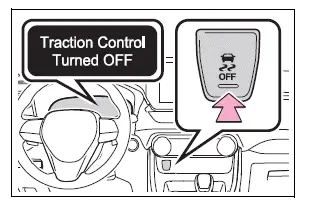
â– When it is difficult to free the vehicle
Press  to turn off TRAC.
WARNING
â– When attempting to free a stuck vehicle
If you choose to push the vehicle back and forth to free it, make sure the surrounding area is clear to avoid striking other vehicles, objects or people. The vehicle may also lunge forward or lunge back suddenly as it becomes free.
Use extreme caution.
â– When shifting the shift lever
Be careful not to shift the shift lever with the accelerator pedal depressed.
This may lead to unexpected rapid acceleration of the vehicle that may cause an accident resulting in death or serious injury.
NOTICE
â– To avoid damaging the transmission and other components
- Avoid spinning the wheels and depressing the accelerator pedal more than necessary.
- If the vehicle remains stuck even after these procedures are performed, the vehicle may require towing to be freed.
 If your vehicle overheats
The following may indicate
that your vehicle is overheating.
The engine coolant temperature
gauge shows the red zone or a
loss of engine power is
experienced. (For example,
the vehicle speed doe ...

Other materials:
Diagnosis system
Description
Air conditioning system data and the diagnostic
trouble codes (dtcs) can be read through the
data link connector 3 (dlc3) of the vehicle. When
the system seems to be malfunctioning, use the
intelligent tester to check for malfunctions and
perform troubleshooting.
...
Auto lsd indicator light does not come on
Description
Refer to the description of "auto lsd indicator light remains on" (see page
bc-164).
Wiring diagram
Refer to the auto lsd indicator light circuit (see page bc-165).
Inspection procedure
Check can communication system
Check if the can communication system dtc is ...
Operation check
Illuminated entry system operation check
The illuminated entry system controls the following
lights:
Ignition key cylinder light*1 or transponder key
amplifier*2
Foot light
Map light and room light
Hint:
*1: W/o engine immobiliser system
*2: W/ engine immobiliser ...
